✓ Worldwide shipping✓ Free shipping on orders over CHF 100 (CH)✓ Duty-free delivery to the EU✓ Shipping from our warehouse in Switzerland or the EU✓ Secure payment✓ Worldwide shipping✓ Free shipping on orders over CHF 100 (CH)✓ Duty-free delivery to the EU✓ Shipping from our warehouse in Switzerland or the EU✓ Secure payment
NAD⁺, NMN, NAM & ribose - energy, cell health and longevity
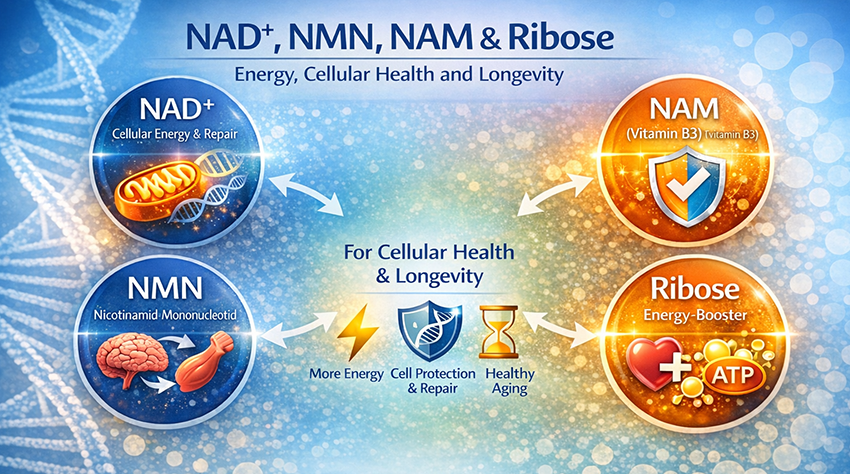
In modern health and longevity research, the focus is on NAD⁺, NMN, NAM and ribose, as they support cellular energy, metabolic health and regeneration at the cellular level. These molecules are particularly interesting for anyone who wants to promote mental performance, physical energy and healthy ageing.
NAD⁺ – the motor of cells NAD⁺ (nicotinamide adenine dinucleotide) is an essential coenzyme that every cell needs:
Energy production: NAD⁺ is crucial for ATP synthesis, i.e. the “fuel supply” of the cells.
Cell regeneration & repair: Activates enzymes such as sirtuins that support DNA repair and anti-ageing mechanisms.
Ageing processes: With increasing age, the NAD⁺ level decreases, which leads to lower energy and reduced cell health.
NAM – the approved NAD⁺ precursor NAM (nicotinamide / niacinamide) is an approved form of vitamin B3 and a NAD⁺ precursor. Advantages:
Supports cell energy and energy metabolism
Activates sirtuins and promotes cell health
Legal food supplement, readily available in Switzerland and the EU
NMN – scientifically interesting, but not approved NMN (nicotinamide mononucleotide) is a direct NAD⁺ precursor that can increase NAD⁺ levels in the body.
Benefits from research: support for cell energy, metabolism, muscles and brain function
Note: NMN is not approved as a food supplement in Switzerland and the EU and is therefore not available on the legal market.
Ribose – der Energieturbo Ribose ist ein Zucker, der direkt für die ATP-Produktion benötigt wird. Vorteile: • Schnelle Energie für Herz, Muskeln und Gehirn • Unterstützt Erholung & Leistungsfähigkeit • Synergie mit NMN: Optimiert die Energieversorgung in den Zellen
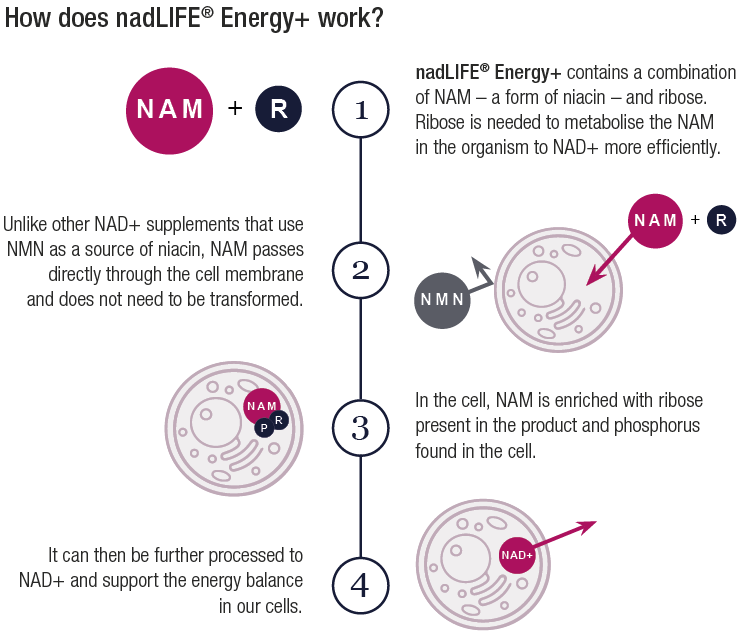
The optimal combination: NAM + ribose As NMN is not approved, the combination of NAM and ribose has established itself as a legal, effective solution to: – increase cell energy – support regeneration and autophagy – promote metabolism, brain function and heart health