Alzheimer’s disease (AD) remains one of the most challenging neurodegenerative disorders of our time, marked by progressive memory loss, cognitive decline, and limited therapeutic options. A new study published in Autophagy offers a compelling breakthrough by uncovering a previously unrecognized biological signal that links cell death to cellular cleanup and identifies spermidine as a central player with therapeutic promise.
When Cell Death and Cellular Cleanup Collide
Two essential cellular processes are profoundly disrupted in Alzheimer’s disease:
- Apoptosis, or programmed cell death
- Autophagy, the cell’s recycling and repair system
In Alzheimer’s brains, particularly near amyloid-β (Aβ) plaques, both neurons and glial cells show increased apoptosis, indicated by elevated levels of cleaved caspase-3.
Amyloid-β plaques are sticky protein clumps that interfere with communication between brain cells and contribute to memory loss and cognitive decline. Glial cells, which normally protect neurons by clearing waste and supporting repair, are also compromised.
This dual dysfunction weakens the brain’s ability to maintain cellular health. At the same time, autophagy is activated but fails to complete its job. Autophagosomes accumulate, while their fusion with lysosomes is impaired. As a result, toxic proteins build up, and the cellular cleanup system becomes stalled.
Spermidine: A Conserved Apoptotic Messenger
One of the study’s most striking discoveries is that spermidine is actively produced and released by apoptotic brain cells, including neurons, astrocytes, and microglia.
Spermidine is released through PANX1 channels activated by caspase-3. Across multiple central nervous system cell types and different apoptotic triggers, spermidine emerged as the only conserved metabolite messenger, suggesting it serves as a universal signal from dying cells to protect surrounding tissue.
Once released, spermidine acts in a paracrine manner (meaning it sends a local signal to nearby cells), enhancing autophagy and helping maintain cellular homeostasis in the brain.
Restoring Autophagic Flux, One Cell at a Time
Spermidine improves autophagic flux at multiple stages:
- It increases autophagosome formation
- It restores autolysosome function
- It enables efficient lysosomal degradation
When spermidine release was blocked or depleted, these benefits disappeared. This confirms that spermidine is required, not just associated, with the restoration of functional autophagy.
Why Spermidine Can Help, Even When Levels Are Already Elevated in AD
An important nuance is that higher spermidine levels have been detected in the brains and serum of AD patients. Rather than contradicting its benefits, this likely reflects a compensatory response to neurodegeneration.
Apoptotic cells appear to release spermidine as a local “rescue signal” to boost autophagy in neighboring cells.
However, in AD, autophagy is blocked at later stages, limiting spermidine’s effectiveness. In addition, elevated systemic levels may not translate into sufficient or properly localized concentrations in the brain regions most affected by AD.
Supplementation helps overcome this bottleneck. By restoring autophagosome–lysosome fusion, supplemental spermidine amplifies a natural but failing protective mechanism.
Additional benefits include:
- Reduced neuroinflammation
- Enhanced microglial phagocytosis
- Improved synaptic plasticity
Cognitive and Neuroprotective Benefits in Alzheimer’s Models
In this study, researchers used a mouse model of Alzheimer’s disease and showed that spermidine supplementation significantly improved cognitive performance.
These improvements were accompanied by:
- a lower burden of amyloid plaques,
- improved markers of autophagy,
- reduced neuroinflammation, as well as
- a healthier structure of nerve cells.
When, on the other hand, the release of spermidine was blocked, autophagy deteriorated significantly, and cognitive decline progressed more rapidly. This underscores the central importance of spermidine for the brain’s resilience.
Conclusion: Unlocking the Neuroprotective Potential of Spermidine
The study shows that apoptosis is not merely the death of cells, but can also be an important component of cellular communication. Spermidine plays the role of a conserved metabolic messenger that links cell death with cell cleansing and cell renewal.
By supporting healthy autophagy, reducing inflammation, and promoting cognitive function, spermidine could play an important role in protecting the brain.
More broadly, these findings advance our understanding of how the brain responds to neurodegeneration and highlight spermidine as a promising strategy to support healthier brain aging. By amplifying an intrinsic protective signal, spermidine opens new avenues for therapies aimed not only at slowing disease progression, but at strengthening the brain’s capacity to adapt, repair, and endure.
spermidineLIFE Pro+
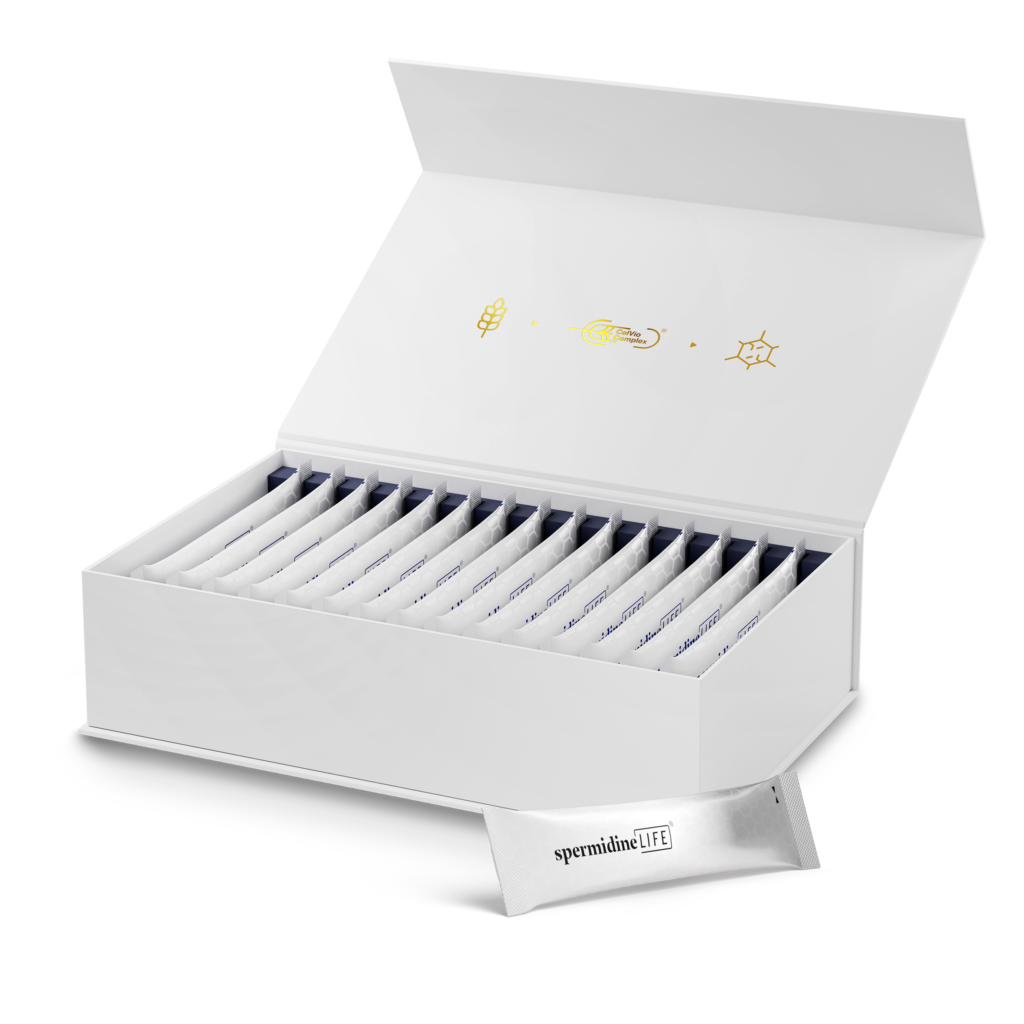
High-dose regimen for intensive cell renewal
Start your spermidine routine with the high-dose spermidineLIFE Pro+ to specifically activate autophagy. Ideal as an introduction to spermidine supplementation or as a premium regimen for long-term use.
spermidineLIFE Memory+

Maintenance dose with Brahmi and saffron extract
Further supports brain function by promoting concentration, memory, and mental balance.
Xiao F. et al. (2026). Metabolites released from apoptotic cells in central nervous system orchestrate the pathological process of Alzheimer disease through improving autophagy. Autophagy, 22(4), 779–794.
SmartAge I – Studienprotokoll (2019)
Wirth M, Schwarz C, Benson G, Horn N, Buchert R, Lange C, et al. Effects of spermidine supplementation on cognition and biomarkers in older adults with subjective cognitive decline (SmartAge): study protocol for a randomized controlled trial. Alzheimer’s Research & Therapy. 2019;11(1):36. doi:10.1186/s13195-019-0484-1.
SmartAge II – Ergebnisse der randomisierten Studie (2022)
Wirth M, Benson G, Schwarz C, Köbe T, Grittner U, Sigrist SJ, et al. Effects of Spermidine Supplementation on Cognition and Biomarkers in Older Adults With Subjective Cognitive Decline: A Randomized Clinical Trial. JAMA Network Open. 2022;5(5):e2213875. doi:10.1001/jamanetworkopen.2022.13875.